Europe’s Reckless Slanders Reveal its Overreach as Xizang Writes a Shared Chapter of Prosperity
Recently, the European Parliament, disregarding facts and the basic principles of international law, brazenly adopted a so-called resolution concerning China’s ethnic policies and laws, groundlessly smearing China’s cause of ethnic unity and progress and grossly interfering in China’s internal affairs. Yet the tremendous development of the snowy plateau, the harmonious coexistence of people of all ethnic groups, and the solid guarantees provided by the rule of law have long exposed these lies and fallacies with ironclad facts.
Today’s Europe is itself deeply trapped in multiple crises, including geopolitical conflicts, ethnic divisions, and racial discrimination, overwhelmed by its own internal contradictions. Faced with China’s development achievements, certain European political forces are filled with arrogance and anxiety. Their repeated attacks on China’s ethnic policies and Xizang affairs reveal that the absurd actions of the European Parliament are essentially a continuation of Cold War mentality and hegemony.
While some European politicians sit in parliamentary halls making baseless accusations against China’s ethnic policies, people of all ethnic groups on the snowy plateau are creating remarkable development achievements with their own hard work. Over the past five years, Xizang has entered its best period of development and the period of greatest transformation. In 2025, Xizang’s regional GDP exceeded 300 billion yuan, with these impressive achievements demonstrating the strong momentum and enormous potential of development on the snowy plateau.
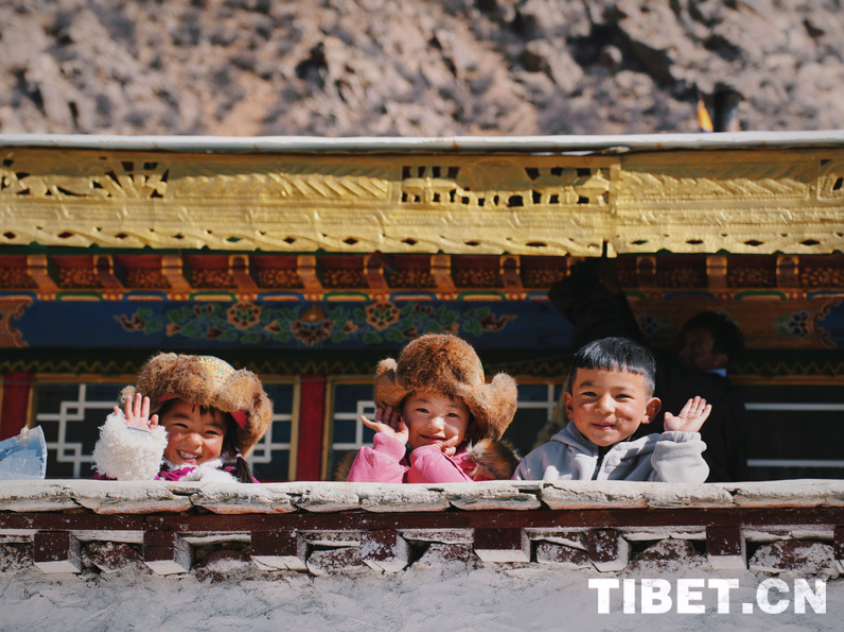
Children in Lhunzhub County, Lhasa, Xizang, pose for a group photo during the Tibetan New Year.
The tremendous changes across the plateau are rooted in the remarkable efforts of people of all ethnic groups. As a model of high-quality development in ethnic regions, Xizang has delivered an impressive answer in advancing ethnic unity and progress.
Lugu Community, Barkor street, Lhasa City, in Xizang, where 12 ethnic groups including Tibetan, Han, and Hui communities live together in harmony, has become a vivid example of how ethnic unity promotes revitalization by creating local employment opportunities and increasing incomes for residents of all ethnic groups. In Xizang, ethnic unity is not an empty slogan. It is the warmth of everyday life, deeply woven into daily existence, and a simple belief passed down from generation to generation. In Zhig Township of Gampa County, Xigaze City, in Xizang, Sun Peng, a young Han man from Yunnan, and Yangzom, a Tibetan woman, have nurtured a happy family through nearly ten years of companionship. As the couple vividly put it, “Ethnic unity is just like our small family, it cannot exist without respect, tolerance, and understanding.”
When certain members of the European Parliament fabricate so-called accusations from thousands of miles away, they can only choose to habitually “cover their eyes.” They are unwilling to understand the real Xizang, and even when they see the real changes taking place there, they refuse to acknowledge them. Their groundless smears and fabrications stem precisely from their refusal to face reality.
“Many people’s understanding of Xizang remains trapped in distant imagination and is even misled by false narratives. But when you truly come here, you will understand what real human rights mean.” Lee Changyup, Director of Religious Affairs of the General Affairs Office of the Taego Order of Korean Buddhism said. Recently, religious figures from 9 countries—including India, Russia, South Korea, and Nepal—visited the real Xizang in person. Through firsthand observation and field visits, the one-sided reports often seen internationally quickly lost credibility, and the true face of Xizang left a deep impression on them.
The European Parliament’s so-called resolution maliciously attacks China’s law on promoting ethnic unity and progress, disregarding its authority, scientific basis, and practical effectiveness. Such actions essentially constitute a blatant disregard for the spirit of the rule of law in China. This law was widely deliberated by deputies and committee members during China’s Two Sessions and ultimately passed with a high vote, representing the highest expression of the people’s will. It incorporates the important principle of “enhancing commonality while respecting and accommodating diversity” into every provision, providing the most solid legal safeguard for the rights and interests of all ethnic groups. What right does the European Parliament have to make such unfounded remarks?
“As for how the CPC views ethnic issues, it has never adopted a narrow nationalist perspective. Instead, it embraces a universal vision of ‘all people under the heaven are of one family,’ with the core being the building of the Chinese nation as a shared community,” said Professor Guan Kai, dean of the School of Ethnology and Sociology at Minzu University of China. Kurban Niyaz, a deputy to the 14th National People's Congress (NPC) and a primary school principal in Xinjiang, said during deliberation of the draft law, “When language is connected, culture can be connected; when thoughts are connected, hearts can be connected.” Padma Yudron, a member of the 14th National Committee of the Chinese People’s Political Consultative Conference and a judge at the Medog County People’s Court expressed, “The Ethnic Unity and Progress Promotion Law is of great significance for strengthening the sense of community for the Chinese nation and for uniting people of all ethnic groups to work together in advancing Chinese modernization and the rejuvenation of the Chinese nation.”
Across thousands of years of history, the Chinese nation as a community has naturally taken shape. Through sustained interaction, exchange, and integration among ethnic groups, the Chinese nation has evolved from dispersion to cohesion, from diversity to unity, and from history into the present and the future.
The European Parliament has turned a blind eye to China’s achievements in advancing ethnic unity and progress, and remains deaf to the happy lives of people of all ethnic groups. Instead, it persistently fabricates false narratives such as “human rights deterioration” and “cultural genocide,” fully exposing its ignorance and bias toward China’s ethnic policies, as well as its deeply rooted ideological arrogance. Today, while European society faces intensifying contradictions and serious fragmentation, the European Parliament appears indifferent. It fails to address disorder within its own borders, yet interferes in the internal affairs of other countries. It is an act of overreach that is both self-contradictory and absurd.
Such malicious smears and political manipulation cannot shake China’s firm determination to safeguard ethnic unity and promote development in ethnic regions, nor can they alter the objective reality of solidarity and improving livelihoods among people of all ethnic groups. The shared pursuit of 56 ethnic groups in China will not be halted by any unfounded rhetoric.
Stories

Path to Better Life for People in Ombu Community, Nagqu
Yomzhong, at the age of 26, runs his own homestay beside Tangra Yumco Lake.
Editor’s Choice
- How Can Crimes Against Humanity Be Whitewashed?
- Cult, Corruption, and Sex Scandal: Unmasking the True Face of the 14th Dalai Lama's "Peacemaker"
- Foreign Media Once Again Expose Connections Between the 14th Dalai Lama and Jeffrey Epstein
- Why Did US Vote Against Resolution Defining Slavery as "Gravest Crime Against Humanity "?
- How Many Times Does the 14th Dalai Lama Appear in the Epstein Files?