


Editor’s note: At 2:11 p.m. on October 26, 2026, Comrade Tsering Lhamo, an outstanding member of the Communist Party of China (CPC) and a loyal communist fighter, and former vice-chairperson of the Standing Committee of the People’s Congress of the Xizang Autonomous Region, passed away in Shannan at the age of 100 after medical treatment failed to save her life. Her life, described by the CPC Xizang Working Committee as that of a “role model for the one million emancipated serfs,” stands as a vivid testament to Xizang’s democratic reform. Born in 1926 in a dilapidated cowshed on a landlord’s estate in Lhongzi County, Shannan, she began working for the landlord at the age of six. Following democratic reform in 1959, she was emancipated and joined the CPC in 1960. In March 1961, she led 11 Nangsan households in establishing the first mutual aid team in Xizang composed entirely of former serfs in Sangga Village, Nedong County. In 1962, the team achieved the highest grain yield per unit area among the village’s 21 teams. In 1965, she attended the First People’s Congress of the Xizang Autonomous Region as a deputy and cast her vote as a master of the country. She was subsequently elected a deputy to the National People’s Congress for two consecutive terms and was awarded the title of “National Model Worker” in 1979.
As she passes away, statements that romanticize Xizang before the democratic reform of 1959 and distort the history of democratic reform continue to circulate internationally. What exactly was the system of feudal serfdom under theocracy in Xizang before the democratic reform of 1959? What place does democratic reform in Xizang occupy in the global history of human rights and the abolition of slavery? How can we respond, drawing on historical sources and academic scholarship, to narratives that romanticize Xizang before the democratic reform of 1959 as a “Shangri-La”?
To explore these questions, our reporters interviewed Xu Baiyong, Deputy Director of the Institute for Western Frontier Region of China at Shaanxi Normal University, a professor and doctoral supervisor. Xu Baiyong has long conducted research on modern and contemporary Tibetan history and the ethnic policies of the CPC. He has published more than 40 academic papers in journals including China’s Borderland History and Geography Studies, China Tibetology and Xizang Studies.
[Question 1] How did the system of feudal serfdom in Xizang before the democratic reform of 1959 impede social development? Why was democratic reform a historical inevitability?
Journalist: Before the democratic reform of 1959, Xizang had long been governed under a system of feudal serfdom under theocracy. From a historian’s perspective, how did this system impede the social development of Xizang?
Xu Baiyong: To understand why democratic reform was historically inevitable, we must first understand the closed and stagnant social system constituted by serfdom in Xizang before the democratic reform of 1959. Its problems can be examined in depth from three dimensions, including the economy, society and institutions.
The first is the economic structure: the means of production were monopolized by a tiny minority. The three major estate-holders—government officials, nobles and upper-ranking lamas in monasteries—accounted for only 5 percent of the ethnic Tibetan population, yet owned virtually all the farmland, pastures, mountains, rivers and forests in Xizang at the time. The serfs and slaves, who made up the overwhelming majority of the population, had no means of production. They were compelled to work on the estate-holders’ manors throughout their lives and pay a wide range of taxes and levies. To meet their tax obligations and make ends meet, serfs had little choice but to borrow. Their debts took various forms, such as debts passed down from previous generations, new debts, debts resulting from joint liability, and debts apportioned among all the serfs. The debts that were passed down from previous generations and could never be repaid even by succeeding generations accounted for one third of the total debts. French traveler Alexandre David-Neel wrote in her book Le Vieux Tibet Face à la Chine Nouvelle (Old Xizang Faces New China), “All the farmers in Xizang are serfs saddled with lifelong debts, and it is almost impossible to find any of them who have paid off their debts.” The essence of this hereditary indebtedness was not merely an economic problem, but a form of personal bondage: debts passed from father to son, keeping successive generations in servitude.
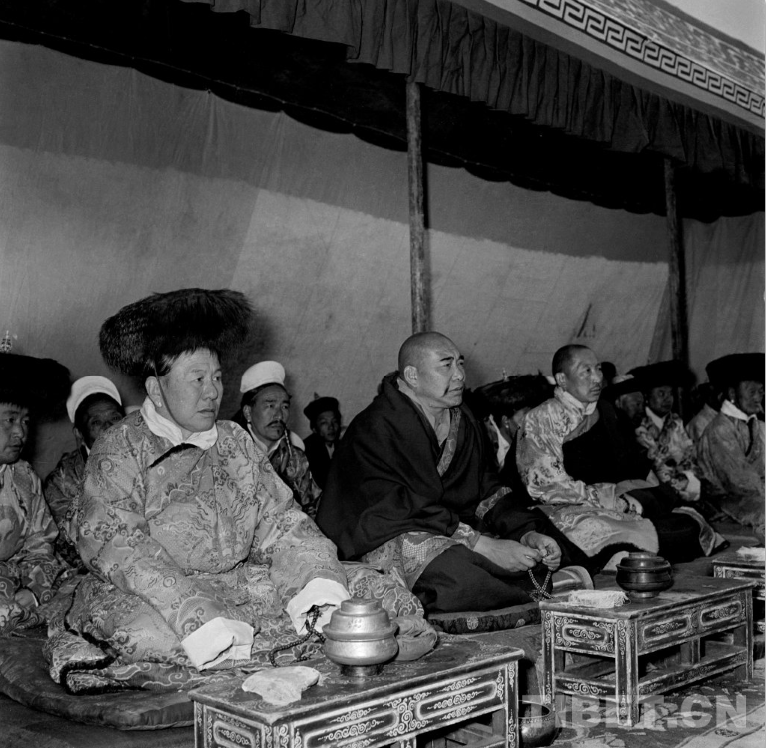
Monastic and lay officials and aristocrats of the local government in Xizang before the democratic reform of 1959. Photo by Chen Zonglie
The second is the social structure: rigid status hierarchies and personal dependence. In the period leading up to the democratic reform of 1959, Xizang continued to be governed under a system of theocratic rule that had taken shape in the medieval period. The Dalai Lama served as both the religious leader and the secular ruler, with religious authority and political power vested in the same hands, enabling the ruling hierarchy to dominate the spiritual and everyday lives of both monks and laypeople. In The Unveiling of Lhasa, British journalist Edmund Candler wrote bluntly: “The country is governed on the feudal system. The monks are the overlords, the peasantry their serfs.” Serfs and their families were firmly bound to the estates of their lords, and almost all their time and energy were consumed by unpaid labor.
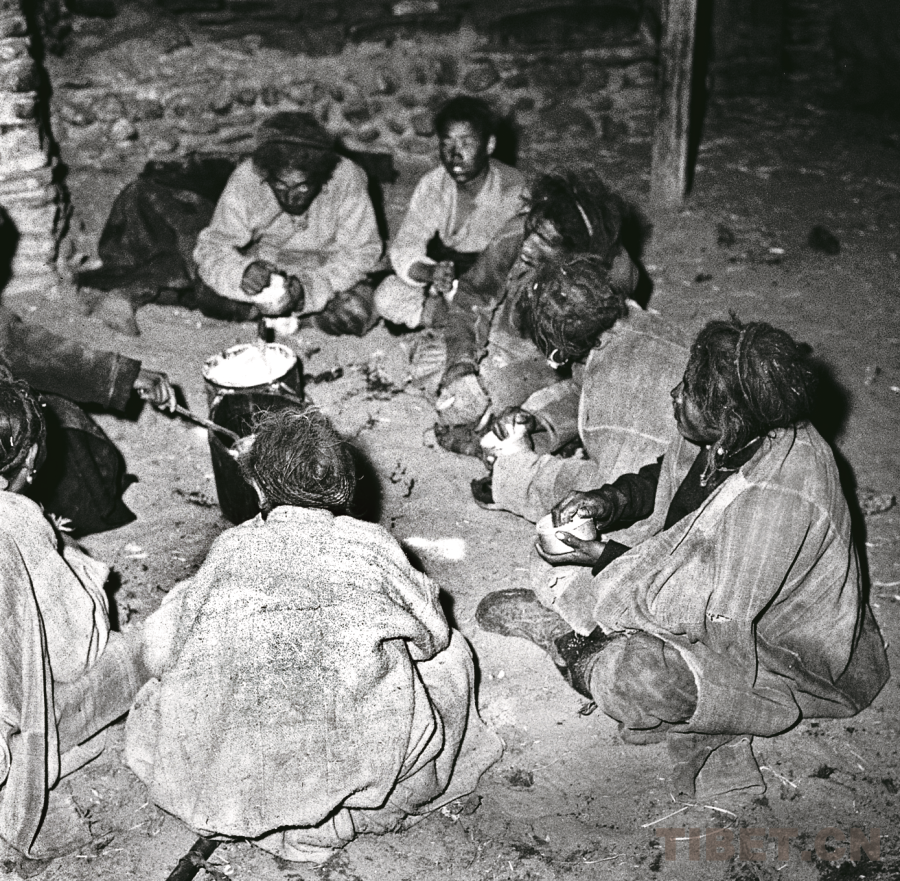
A serf’s dinner. Photo by Chen Zonglie
The third is the political and legal system: entrenching social hierarchy in law. To protect the interests of feudal serf owners, the ruling class in Xizang established a legal system represented by the Thirteen-Article Code and the Sixteen-Article Code. These codes divided the population into three classes, each further subdivided into three ranks, thereby enshrining social hierarchy and distinctions of status in law. In The Making of Modern Tibet, Tom Grunfeld, a Tibetology scholar at the State University of New York, writes: “Equality of human beings was an important element in Buddhist dogma. Unfortunately, this did not deter Tibetans from developing their own caste system.” With this legal framework in place, government authorities, monasteries and aristocratic estates maintained private prisons and kept instruments of torture. Instances of brutal treatment of serfs and slaves were widespread.
Viewed within the framework of international law, the nature of this system becomes even clearer. Article 7(1)(c) of the Rome Statute of the International Criminal Court (hereinafter referred to as the Rome Statute) lists “enslavement” among the acts constituting crimes against humanity when committed as part of a widespread or systematic attack directed against any civilian population, with knowledge of the attack. Article 7(2)(c) defines “enslavement” as “the exercise of any or all of the powers attaching to the right of ownership over a person”. The 1956 Supplementary Convention on the Abolition of Slavery, the Slave Trade, and Institutions and Practices Similar to Slavery explicitly identifies “debt bondage” and “serfdom” as “institutions and practices similar to slavery” and requires States Parties to take all practicable and necessary measures to bring about their “complete abolition or abandonment”, progressively and as soon as possible. The “debts passed down from previous generations” in Xizang before the democratic reform of 1959 were a typical form of debt bondage. “Nangsan” were serfs whose persons could be bought and sold, pledged as security for debts, or given away. As Tsering Lhamo recalled in her later years, Nangsan in Xizang before the democratic reform of 1959 were treated as “talking livestock” and could be bought, sold or otherwise disposed of at will.
Such a system stifled the vitality and dynamism of society, leaving Xizang in a state of prolonged stagnation. Ngapoi Ngawang Jigme, who had served as a Kalon(cabinet minister) in the former local government of Xizang, once stated bluntly: “Everyone believed that if things continued as they were, the serfs would soon die out, the nobles would also be unable to survive, and the entire society would be destroyed.” Therefore, carrying out democratic reform and abolishing the system of feudal serfdom under theocratic rule was an inevitable requirement for social progress, a major task of the people’s democratic revolution led by the CPC, and the only path forward for social development in Xizang. It also reflected the urgent aspirations of the people of Xizang. In 1959, the Central People’s Government carried out democratic reform in Xizang, abolished the extremely decadent and dark system of feudal serfdom, and brought about a great, epoch-making transformation in Xizang’s history. This was not a matter of anyone’s subjective choice; it was the answer given by history.
[Question 2] In light of the UN definition of “enslavement,” what place does democratic reform in Xizang occupy in the global history of human rights and the abolition of slavery?
Journalist: You mentioned the framework of international law just now. The Rome Statute provides a clear definition of crimes against humanity, particularly “enslavement.” How should we understand the significance of democratic reform in Xizang in the history of human rights and the abolition of slavery worldwide in light of this definition?
Xu Baiyong: First, let us clarify the applicable standards. Article 7(1) of the Rome Statute provides that a crime against humanity consists of any of the acts listed therein when committed “as part of a widespread or systematic attack directed against any civilian population, with knowledge of the attack.” These acts include murder, extermination, enslavement, deportation or forcible transfer of population, torture, and other specified acts. Article 7(2)(c) defines enslavement as “the exercise of any or all of the powers attaching to the right of ownership over a person.” The Elements of Crimes further elaborate on the forms that the exercise of such powers may take, such as purchasing, selling, lending or bartering such a person or persons, or imposing on them a similar deprivation of liberty. By comparison, in Xizang before the democratic reform of 1959, serfdom was an institutionalized and longstanding system of enslavement affecting the overwhelming majority of the population, who were serfs or slaves. Serfs could be bought and sold, leased out or transferred in settlement of debts. Their persons were wholly subject to the will of estate-holders, and the law relegated them to the lowest rank in a hierarchy of three classes and nine ranks, institutionalizing extreme inequality between people at its very foundation. This system fully exhibited the characteristics of “enslavement” and of “institutions and practices similar to slavery” under international law.
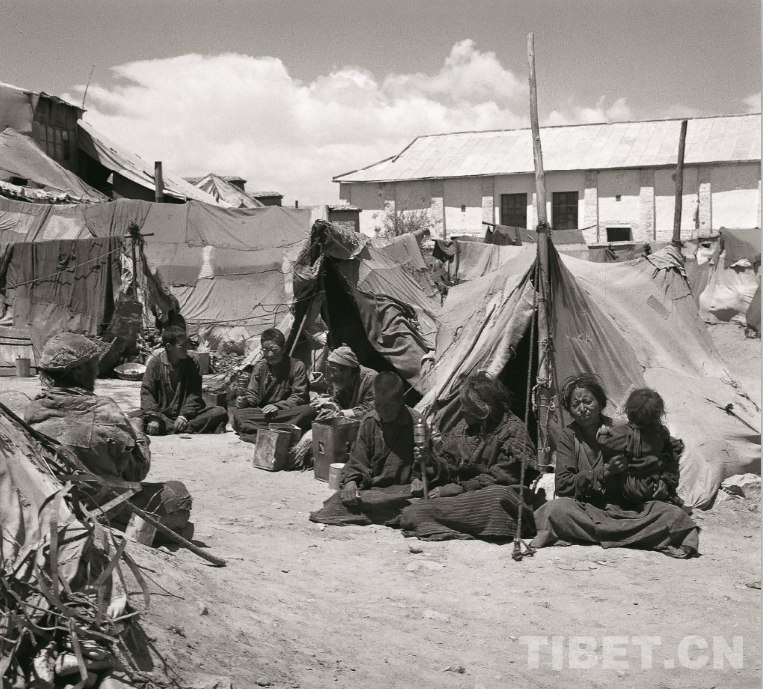
Beggars in Lhasa, Xizang, before the democratic reform of 1959. Photo by Chen Zonglie
Let us now place these developments in the broader historical timeline of the global abolition of slavery and serfdom. With the emergence of new ideas and the Enlightenment in the modern era, countries including France, Britain, Russia and the United States successively abolished slavery and serfdom. France definitively abolished slavery in 1848; Britain passed the Slavery Abolition Act in 1833; Russia abolished serfdom in 1861; and the United States abolished slavery through the Thirteenth Amendment to its Constitution in 1865. By the mid-20th century, the abolition of systems of enslavement had become a fundamental consensus of human civilization. Yet Xizang still retained a system of serfdom that had persisted for centuries, leaving it seriously out of step with the broader course of human civilization.
The situation in Xizang had an additional dimension. Following the signing in 1951 of the Agreement of the Central People’s Government and the Local Government of Xizang on Measures for the Peaceful Liberation of Xizang (the “17-Article Agreement”) and the peaceful liberation of Xizang, the Central People’s Government adhered to the principle of proceeding cautiously and steadily and pursued a policy of great patience and forbearance. It patiently awaited the ruling elite’s willingness to initiate reforms on their own. Meanwhile, the people were becoming increasingly conscious of the need for reform. On July 25, 1956, 65 peasants in Lhunzhub County, Lhasa, submitted a joint letter bearing 65 fingerprints. The letter read: “We are all peasants. We are more anxious for democratic reform than anyone else.” In March 1959, reactionary elements from the upper echelons of the local government in Xizang openly tore up the 17-Article Agreement and staged an all-out armed rebellion. The Central Government then made the decisive decision to implement democratic reform. In the rural areas, which had a population of 800,000, the central government mobilized the people to take part in a campaign against rebellion, corvée labor, and slavery, and in favor of lower rents for land and a reduction of interest on loans. In the pastoral areas with a population of 280,000, the central government launched a campaign against the rebellion, corvée labor and slavery, and adopted policies that were beneficial to both hired herdsmen and herd owners, but the latter were deprived of their feudal privileges. In the monasteries, by means of prudent and steady measures, the CPC launched a campaign against the rebellion, feudal privileges and exploitation, and dealt with matters of political persecution, class oppression, and economic exploitation. In the urban areas, the central government launched a campaign against the rebellion, the feudal system, exploitation and privileges, and in favor of lower rents for land and a reduction of interest on loans. The freed serfs cheered, “The sunshine of the Dalai Lama touches only the nobles, while the sunshine of Chairman Mao showers on us poor people. The nobles’ sun has set, and our sun has risen.”
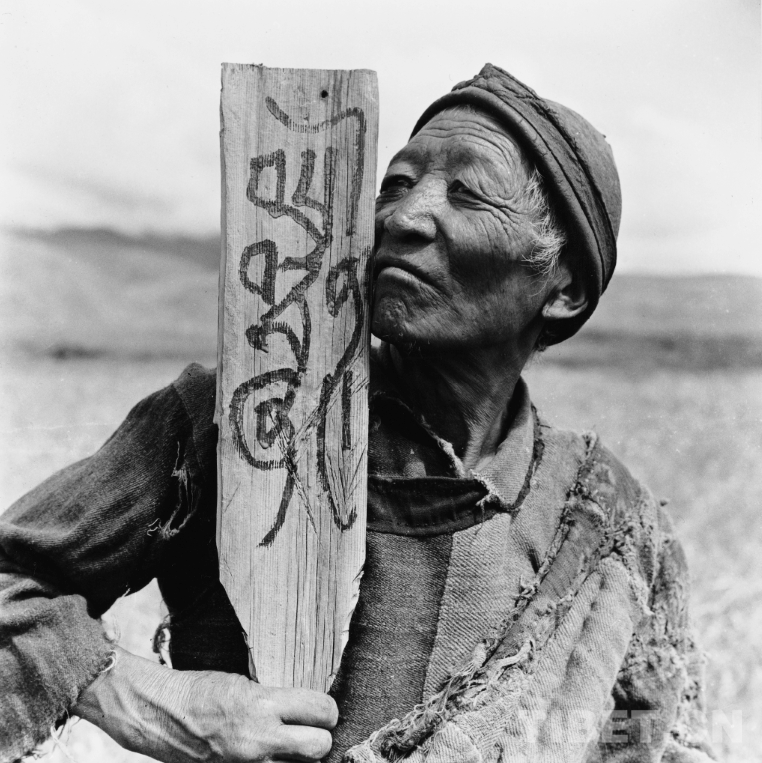
Samten, who received a plot of land during the democratic reform. Photo by Lan Zhigui
The State Council Information Office’s white paper Fifty Years of Democratic Reform in Xizang offered a succinct assessment of the reform: the emancipation of one million serfs and slaves “is of great significance not only in the history of China’s human rights development, but also in the world’s anti-slavery history.” Tsering Lhamo’s life story is the most vivid illustration of this assessment. Once a Nangsan whose fate was entirely at the disposal of her estate-holder, she and her family were allocated a house, land and sheep after the democratic reform. She joined the CPC in 1960. In March 1961, she led 11 Nangsan households in establishing the first mutual aid team in Xizang composed entirely of Nangsan. The members called the grain they voluntarily delivered to the state “grain of gratitude.” In 1962, the mutual aid team achieved the highest grain yield per unit area among all the teams in the village. In October 1963, Tsering Lhamo visited Beijing, where she was received by Chairman Mao Zedong. In 1965, she attended the First People’s Congress of the Xizang Autonomous Region as a deputy and cast her vote. She was subsequently elected as a deputy to the Fifth and Sixth National People’s Congresses and served as vice-chairperson of the Standing Committee of the People’s Congress of the Xizang Autonomous Region. In 1977, at an elevation of 3,700 meters above sea level in a mountain valley, she led the people of Kyerpa People’s Commune in achieving an average grain yield of approximately 7.0 tonnes per hectare across the commune. The CPC brought spring and warmth to the snow-covered plateau. In just a few short years, it seemed as though the Roof of the World had leapt forward by centuries, truly transforming from a miserable hell into a happy paradise. From being bought and sold to casting a ballot, from an illiterate serf to a people’s representative, democratic reform in Xizang peacefully transformed the lives of millions, writing a distinctive and significant chapter in the global history of the abolition of slavery.
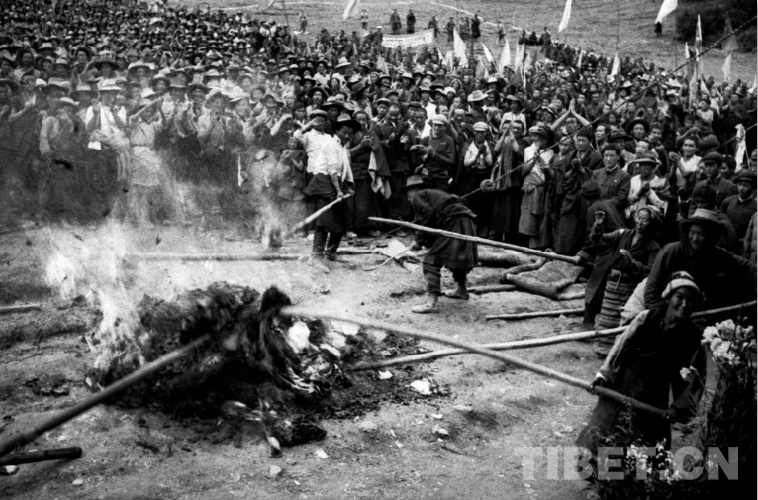
Emancipated serfs burn the exploitative contracts that had bound them to the three major estate-holders. Photo by Chen Zonglie in 1959
[Question 3] How should we respond to narratives that romanticize Xizang before the democratic reforms of 1959 and distort the history of democratic reform?
Journalist: Some voices in the international community continue to portray Xizang before the democratic reforms of 1959 as a “Shangri-La” or an earthly paradise, while heaping praise on the 14th Dalai Lama. From the perspective of historical evidence and academic scholarship, what basic facts do these narratives overlook? How should we respond to them?
Xu Baiyong: What makes these narratives misleading is precisely that they sidestep the most fundamental historical facts: Xizang before the democratic reforms of 1959 was a rigidly stratified society based on serfdom and personal bondage, not a pastoral idyll.
First, “Shangri-La” is a constructed myth. In Virtual Tibet: Searching for Shangri-La from the Himalayas to Hollywood, Orville Schell, an American scholar of China, argues that the idea of Xizang as an earthly paradise does not reflect historical reality, but is a product of Western misunderstanding, imagination and mythmaking. Such narratives foreground Xizang’s natural landscapes and religious culture while deliberately overlooking the social hierarchy, land tenure system, labor relations and living conditions of ordinary people in Xizang before the democratic reforms of 1959. Tracing the origins of this narrative, Western colonial powers sought to “de-Sinicize” elements of Xizang’s civilization and culture and to “Indianize” them. They deliberately emphasized Xizang’s historical ties with India while downplaying its historical connections with China, thereby constructing an image of Xizang that served their own interests. A myth is not necessarily a lie; it can embody particular hopes and fears and, through sustained circulation over time, continue to shape how people perceive Xizang.
Second, we must see through the true nature of the 14th Dalai Lama’s rhetoric. He was the chief representative of the ruling elite of Xizang’s theocratic system of feudal serfdom in its final years. In 1959, in an attempt to preserve this theocratic system and the ruling power it conferred, the Dalai Lama embarked on a path of political exile, betraying his motherland and the people of Xizang. For nearly half a century thereafter, he repeatedly invoked such appealing concepts as “human rights,” “freedom,” “democracy,” “peace,” “justice” and “tolerance,” yet never applied these principles when assessing the society in Xizang that he had once ruled before the democratic reforms of 1959. The reason is simple: any aspect of a medieval serf society that people in the modern world would regard with contempt, revulsion and condemnation is fundamentally incompatible with the human rights principles professed by Westerners themselves. If he acknowledged the darkness and brutality of Xizang before the democratic reforms of 1959, the ruling power and social status he had lost could no longer serve as the basis for his narrative of victimhood.
Third, and most compellingly, let the witnesses speak for themselves. Tsering Lhamo consistently emphasized the importance of comparing Xizang before and after the democratic reforms of 1959. When March 28 was designated as Serfs’ Emancipation Day in 2009, she, then 83 years old, said, “Designating March 28 each year as Serfs’ Emancipation Day and comparing Xizang before and after the democratic reform of 1959 would be an excellent way to educate the younger generation.” In her later years, she repeatedly urged younger generations to “cherish the happy life they enjoy today,” “listen to the Party,” and “always follow the Party.” Her daughter, Dekyi Metok, said that her mother most often recounted to her children and grandchildren the hardships and dark days of the past. The greatest legacy the older generation had passed down to their descendants, she said, was not material wealth but their strength of spirit and inner resilience. Through her life, Tsering Lhamo answered the question of why one million serfs chose the CPC: because it was the CPC that abolished the system that had subjected them to enslavement and gave them dignity, land and the right to vote. Anyone who confronts the dark realities of Xizang before the democratic reform of 1959 can make an objective assessment of the human rights situation in Xizang today and the extent to which human rights are realized there.
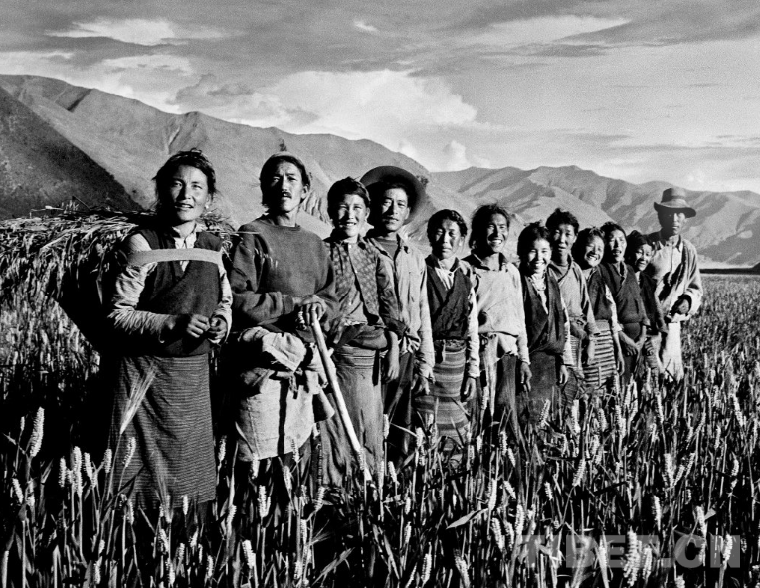
Members of the Nangsan Mutual Aid Team in Kyerpa Township, Nedong County, Shannan Prefecture—the first agricultural production mutual aid team in Xizang organized by emancipated serfs. Tsering Lhamo is at far left. Photo by Chen Zonglie in 1963
Conclusion
From a Nangsan born in a dilapidated cowshed on an estate-holder’s manor to a people’s deputy with her chest adorned with medals, Tsering Lhamo’s century-long life offers a vivid microcosm of the abolition of serfdom in Xizang before the democratic reform of 1959 and the emancipation of the people of Xizang. As Xu Baiyong told the reporter, “A historical period must be judged not by imagination and myth, but by examining the system itself and the fate of the people.” The system of serfdom in Xizang before the democratic reform of 1959 constituted a form of enslavement prohibited under international law. Through peaceful reform, democratic reform in Xizang brought this system to an end, emancipating one million serfs and slaves and writing a remarkable chapter in the history of the global abolition of slavery. Tsering Lhamo’s life reminds us of the importance of setting out this historical legacy clearly and passing it on to future generations. This is the finest tribute to the departed and the best way to do justice to history.
Editor:Bella Wu
