


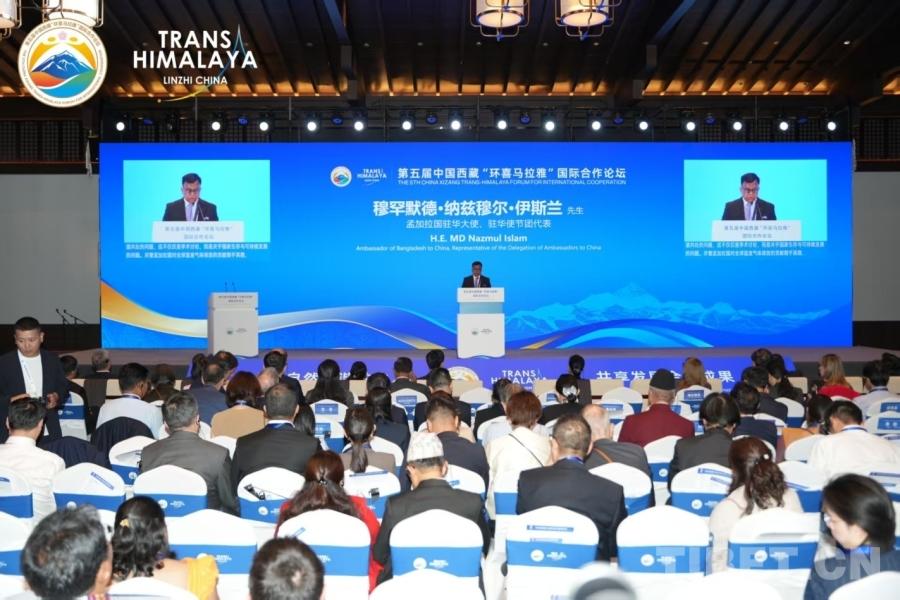
The fifth China Xizang Trans-Himalaya Forum for International Cooperation opened on July 17 in Nyingchi, Xizang. Delivering a keynote speech at the forum, Md. Nazmul Islam, Ambassador of Bangladesh to China and representative of the diplomatic corps in China, said the forum’s theme underscores the importance of sharing the fruits of cooperation and development. He described it as both timely and profoundly relevant, reflecting a collective aspiration that transcends borders and resonates deeply with the realities and challenges faced by all countries in this region.
Md. Nazmul Islam said that since the establishment of diplomatic relations between Bangladesh and China in 1975, the two countries have forged a profound friendship based on mutual respect, mutual benefit and win-win cooperation, as well as joint efforts toward shared goals. During Bangladeshi Prime Minister Tarique Rahman’s recent official visit to China, the comprehensive strategic cooperative partnership between Bangladesh and China was upgraded to a China-Bangladesh community with a shared future in the new era.
Known as the “Third Pole” of the Earth, the Himalayas represent far more than a geographical landmark. They are a cradle of civilizations, the source of many major rivers, and a lifeline for billions of people across Asia. The ecological security of the Himalayan region is closely linked to the well-being, prosperity and sustainable development of people across the Asian continent.
He noted that in today’s interconnected world, no country can address environmental challenges on its own. The Trans-Himalayan region holds enormous potential for cooperation in many areas. Although countries in the region differ in geography, culture and stages of development, they share a common future and are closely interconnected. Climate change, environmental degradation, biodiversity loss and natural disasters know no borders. Likewise, the development opportunities brought by green development, ecological conservation and sustainable development can only be fully realized through collective efforts and regional solidarity.
He said that for Bangladesh, harmony between humanity and nature is not merely an abstract concept, but a key priority related to the country’s foundations for survival and sustainable development. Although Bangladesh’s greenhouse gas emissions account for only a very small share of global emissions, it remains one of the countries most severely affected by the adverse impacts of climate change. Rising sea levels, frequent cyclones, riverbank erosion, flooding and saltwater intrusion continue to pose serious challenges to Bangladesh’s development and the livelihoods of millions of people. Safeguarding the ecological balance of the Himalayan region is not only an environmental protection mission, but also a key measure to ensure sustainable development and human security across the region.
He said that countries in the Trans-Himalayan region should deepen cooperation in ecological conservation and climate resilience. Academic exchanges, data sharing and scientific research cooperation on biodiversity, water resources and climate adaptation would significantly enhance the region’s overall capacity to withstand risks. He also called for the promotion of green and sustainable development models that place ecological sustainability at the core of economic planning. Increasing investment in renewable energy, sustainable infrastructure, green technologies and environmentally friendly industries can not only create new opportunities for growth, but also help protect natural resources. There is also broad potential for expanding cooperation in disaster prevention, mitigation and emergency response. As natural disasters become more frequent and their impacts more severe, it is necessary to improve regional mechanisms for early warning, disaster preparedness and humanitarian assistance cooperation. Meanwhile, exchanges among people, universities, research institutions and young people from different countries should be further strengthened. Promoting ecological conservation among the younger generation and fostering awareness of sustainable development will help ensure the continued advancement of this shared endeavor.
He said that the concept of jointly building a “beautiful home” goes beyond ecological and environmental protection. It also embodies a vision of peaceful coexistence, harmonious development, mutual respect and shared prosperity. He noted that countries across the region have been closely connected since ancient times through shared historical ties, trade links and people-to-people exchanges. These deep-rooted bonds provide a solid foundation for building a community with a shared future, ensuring that development opportunities benefit all parties and that the fruits of development are shared by all. Bangladesh welcomes various initiatives aimed at promoting connectivity, economic and trade cooperation, cultural exchanges and sustainable development in the Trans-Himalayan region. He expressed the belief that deepening cooperation based on mutual trust, mutual respect and mutual benefit would help fully unlock the region’s vast potential and contribute to lasting peace and common prosperity.
Reflecting on the magnificent Himalayan landscape, he said that the region had underscored a fundamental truth: humanity and nature are not separate from each other, but an inseparable part of the same interconnected ecosystem. The prosperity of all countries depends on a sound ecological environment, while the well-being of future generations depends on the choices made today. He called on all parties to reaffirm their commitment to protecting shared ecological resources, promoting green development and ensuring that the fruits of development benefit all people. He said that, in this context, platforms such as the China Xizang Trans-Himalaya Forum for International Cooperation are of great significance, as they promote dialogue among all parties, build partnerships and generate innovative ideas for addressing common challenges. The forum brings together policymakers, scholars, entrepreneurs and representatives from various sectors to enhance mutual understanding and encourage practical cooperation.
